
Australian paramedics take home about 40% more after tax, but they work much longer weeks, and the NHS pension closes part of the gap.
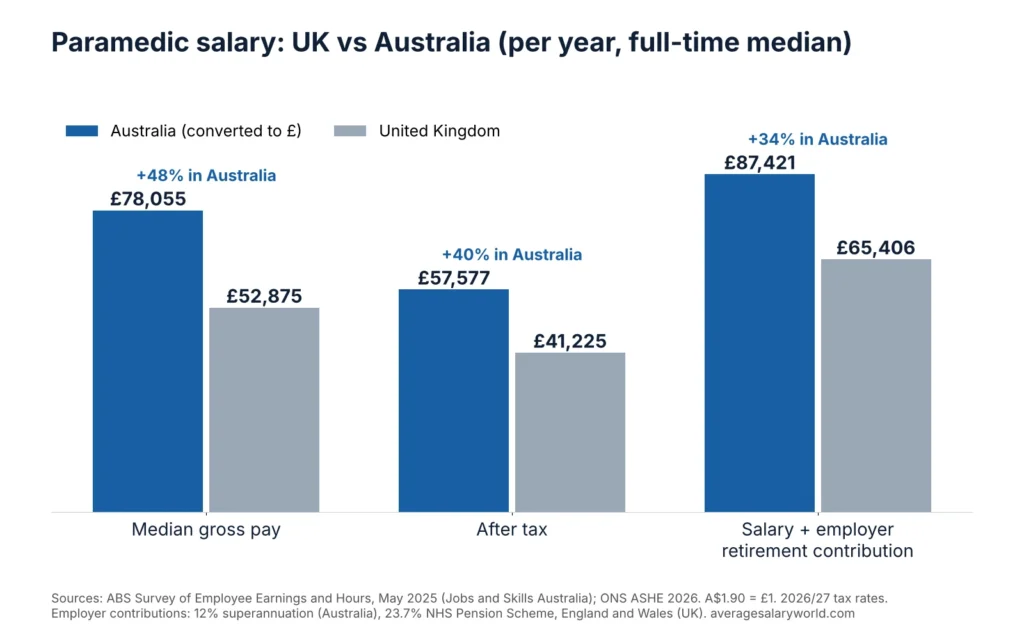
The paramedic salary UK vs Australia gap is one of the largest of any profession we compare. The median full-time paramedic in Australia earns A$148,304 a year (Australian Bureau of Statistics, May 2025), about £78,055 at A$1.90 to the pound. In the UK, the median full-time paramedic earns £52,875 (Office for National Statistics, April 2026). That is a gross gap of about 48%, and after tax it is still around 40%. But two things change the picture more than for most jobs: Australian paramedics work far longer weeks, and the NHS pays a much larger pension contribution than Australian employers do. This guide works through each one with official figures.
Paramedic salary UK vs Australia: the official numbers
Both figures are medians for full-time employees, from each country’s national statistics office, so the comparison counts the same kind of worker on each side. In both countries the figures include overtime and shift payments, which make up a large part of a paramedic’s earnings. Take-home pay uses 2026/27 tax rates in both countries.
| Measure (full-time paramedics) | Australia | Australia in £ | UK |
|---|---|---|---|
| Median gross pay a year | A$148,304 | £78,055 | £52,875 |
| After income tax and Medicare / National Insurance | A$109,395 | £57,577 | £41,225 |
| Take-home a month | A$9,116 | £4,798 | £3,435 |
| Median pay per hour | A$71 | £37.37 | £26.65 |
| Typical hours a week | 47 (average) | — | 37.5 (paid) |
| Employer retirement contribution | A$17,796 (12% super) | £9,367 | £12,531 (23.7% NHS pension) |
| Salary plus employer contribution | A$166,100 | £87,421 | £65,406 |
Sources: Australian Bureau of Statistics, Survey of Employee Earnings and Hours, May 2025, published by Jobs and Skills Australia (ambulance officers and paramedics, A$2,852 a week × 52); ONS Annual Survey of Hours and Earnings 2026 (provisional), full-time paramedics (SOC 2255). Converted at A$1.90 = £1. Australian take-home after income tax and the 2% Medicare levy; UK take-home after income tax and National Insurance, England, Wales and Northern Ireland rates. Retirement contributions: 12% minimum superannuation in Australia; 23.7% employer contribution to the NHS Pension Scheme (England and Wales) in the UK.
On these figures, a median Australian paramedic keeps about £4,798 a month after tax, against £3,435 in the UK: roughly £1,360 a month more. Tax does not explain the gap. On their median salaries, Australians pay about 26% of gross in income tax and Medicare, and UK paramedics about 22% in income tax and National Insurance. The difference is the pay itself.
Part of the gap is much longer weeks
Full-time paramedics in Australia work an average of 47 hours a week, according to Jobs and Skills Australia, against a median of 37.5 paid hours for UK paramedics. That is about a quarter more time at work every week, through long shifts, overtime and on-call work, so a good share of the annual difference is simply more hours. The hourly figures still favour Australia: the median Australian paramedic earns A$71 an hour, about £37.37, against £26.65 in the UK. The two hourly figures come from different survey measures, so treat them as a guide rather than an exact rate, but both point the same way.
The pension: where the UK fights back
This is where paramedics differ from most jobs in our comparisons. Australian salaries are quoted before superannuation, the compulsory retirement saving employers pay on top. Since July 2025 the minimum is 12% of ordinary earnings, worth about A$17,796 a year on the median paramedic’s salary. But most UK paramedics work for NHS ambulance services and belong to the NHS Pension Scheme, where the employer contribution is 23.7% of pensionable pay in England and Wales: about £12,531 on a salary equal to the UK median. Add each employer’s contribution to the salary and the Australian package is worth about £87,421 against £65,406 in the UK: a gap of around 34%, smaller than the 48% gap in salary alone. The NHS scheme is a defined benefit pension, which pays a guaranteed income in retirement, so its value to you depends on how long you stay in it.
Does the cost of living cancel it out?
Partly, not entirely. Australia is more expensive than the exchange rate suggests: using the OECD’s purchasing-power figures, prices there work out about 8% higher relative to the UK than the market rate implies. Adjusting for that trims the after-tax advantage for paramedics from about 40% to about 29%. Housing is the big variable. Rents in Sydney and Melbourne can absorb a large share of the difference, while living costs in regional areas are lower. If you are weighing a move, the state and the city matter as much as the country.
To test your own figures, enter your UK salary in the calculator below, with “Paramedic” already selected. It places you at the same point on the Australian pay scale and compares take-home pay in both countries.
UK vs Australia Pay Calculator
Pick your job and enter your UK salary to see what the same role pays in Australia, before and after tax, on official earnings data.
| UK | Australia |
|---|
How it works: we place you at the same point relative to typical pay for your job. If you earn 10% above the UK median for your occupation, we compare you with someone earning 10% above the Australian median. Medians are for full-time employees: Australia from the ABS Survey of Employee Earnings and Hours (May 2025), the UK from the ONS Annual Survey of Hours and Earnings (April 2026, provisional). Tax uses 2026–27 rules for a single employee with no other income (UK figures for England, Wales and Northern Ireland). Australian pay is converted at A$1.90 to £1 (ECB, 5 October 2026). Superannuation is paid by the employer on top of salary. Not included: student loans, pension contributions, the Medicare Levy Surcharge, state or regional pay differences and visa costs.
How UK pay works: NHS bands and enhancements
In England, NHS paramedics are paid on the Agenda for Change scale. Newly qualified paramedics usually start on Band 5 (from £32,073 in 2026/27) and move to Band 6 (£39,959 to £48,117) once they complete their consolidation period. Specialist and advanced paramedics can reach Band 7 (£49,387 to £56,515) and above. The median of £52,875 is higher than the top of Band 6 because it includes unsocial hours payments and overtime, which add a significant amount for frontline crews working nights and weekends.
Across all full-time paramedics, the ONS figures show the middle half earning between £43,501 and £60,794, with the lowest-paid tenth under £38,440. To see where any UK salary ranks against other jobs, try our UK salary checker.
Getting registered in Australia
Unlike trades, where each state issues its own licence, paramedics in Australia are registered once, nationally, by the Paramedicine Board of Australia through the Australian Health Practitioner Regulation Agency (Ahpra). That registration is recognised in every state and territory, and anyone using the title “paramedic” must hold it. For a UK paramedic the process looks like this:
- Qualification assessment. UK paramedic degrees are not on the Board’s list of approved or accepted qualifications, so you first submit a qualifications portfolio for assessment. Depending on the result, you are advised to apply for registration straight away, to sit the Board’s competency assessment first, or to consider further study.
- Competency assessment. If required, this assesses whether you can practise safely and competently in Australia, and it must be passed before you apply for registration.
- Registration documents. You will need a certificate of good standing from the HCPC and an international criminal history check. The UK is one of the countries the Board recognises for its English language requirements.
Ahpra charges separate fees for the qualification assessment, the competency assessment and registration, and the fees are non-refundable, so check the current amounts on the Paramedicine Board’s website before you apply.
Visa routes for UK paramedics
Both ambulance officers and intensive care paramedics are on Australia’s Core Skills Occupation List, which means an approved employer, such as a state ambulance service, can sponsor you on the Skills in Demand visa. The skills assessment for migration is carried out by VETASSESS, and it is separate from professional registration with the Paramedicine Board: you need both. Occupation lists and the visas each one opens are reviewed regularly, so confirm the current position with the Department of Home Affairs before planning a move.
Should a UK paramedic move to Australia?
On the numbers, the case is strong: around 40% more after tax, higher hourly pay, and a gap that is still about 34% once the NHS pension is counted. But it comes with real costs. You will need a qualification assessment, possibly a competency assessment, a visa and the expense of the move, and Australian paramedics work considerably longer weeks than most UK crews. For a paramedic early in their career, the financial case is clear. For someone with many years in the NHS Pension Scheme, leaving means giving up future defined benefit pension, and that should be weighed carefully against the higher Australian salary. For how other health jobs compare, see our nurse salary UK vs Australia guide.
Planning the move to Australia?
Ready to make the move? Compare free, no-obligation quotes from up to 5 verified international moving companies. After you submit your request, they’ll contact you with their offers. (Partner service: we may earn a commission.)
Frequently asked questions
Do paramedics earn more in Australia or the UK?
In Australia. The median full-time paramedic there earns A$148,304 a year (ABS, May 2025), about £78,055 at A$1.90 to the pound, against £52,875 in the UK (ONS, April 2026). After tax the gap is about 40%: roughly £4,798 a month in Australia against £3,435 in the UK.
Why are Australian paramedic salaries so high?
Partly because Australian paramedics work longer weeks, an average of 47 hours for full-time staff against 37.5 paid hours in the UK, and their earnings include overtime and shift payments. The hourly median is also higher: about A$71 an hour, or £37.37, against £26.65 in the UK.
Can a UK paramedic work in Australia?
Yes, but you must register with the Paramedicine Board of Australia through Ahpra. UK qualifications go through a qualification assessment first, and you may also need to pass the Board’s competency assessment. Registration is national and recognised in every state and territory.
Is the NHS pension better than Australian superannuation?
The employer pays more into it. NHS employers in England and Wales contribute 23.7% of pensionable pay, against a 12% minimum superannuation contribution in Australia. Counting each employer’s contribution, the gap between the two countries falls from about 48% to about 34%.
Compare more jobs in our UK vs Australia salary comparison, which sets 24 occupations side by side, or see the average salary in Australia and the average salary in the UK. Official sources: Jobs and Skills Australia (ABS earnings data), the ONS Annual Survey of Hours and Earnings 2026, the Paramedicine Board of Australia, NHS Employers and the Department of Home Affairs.