
Radiation therapists, who deliver the daily radiation treatments in cancer care, earn a median of $105,310 a year ($50.63 an hour), according to the Bureau of Labor Statistics’ May 2025 survey. That makes the radiation therapist salary in the USA one of the highest-paid healthcare careers you can reach with a two-year degree — entry-level pay starts near $80,560, while the top 10% clear $156,710. For a role you can train for in an associate program, the earning power is hard to beat.
A small profession with a high floor
Only about 17,000 people work as radiation therapists in the United States, a fraction of the 230,000 radiologic technologists. That small size shows in the pay distribution: even the lowest-paid 10% make around $80,560, almost $30,000 more than the median for all American jobs ($50,980), and the middle half earn between $92,060 and $126,340. The best-paid 10% pass $156,710. Few two-year healthcare paths pay this well across the board.
What a radiation therapist actually does
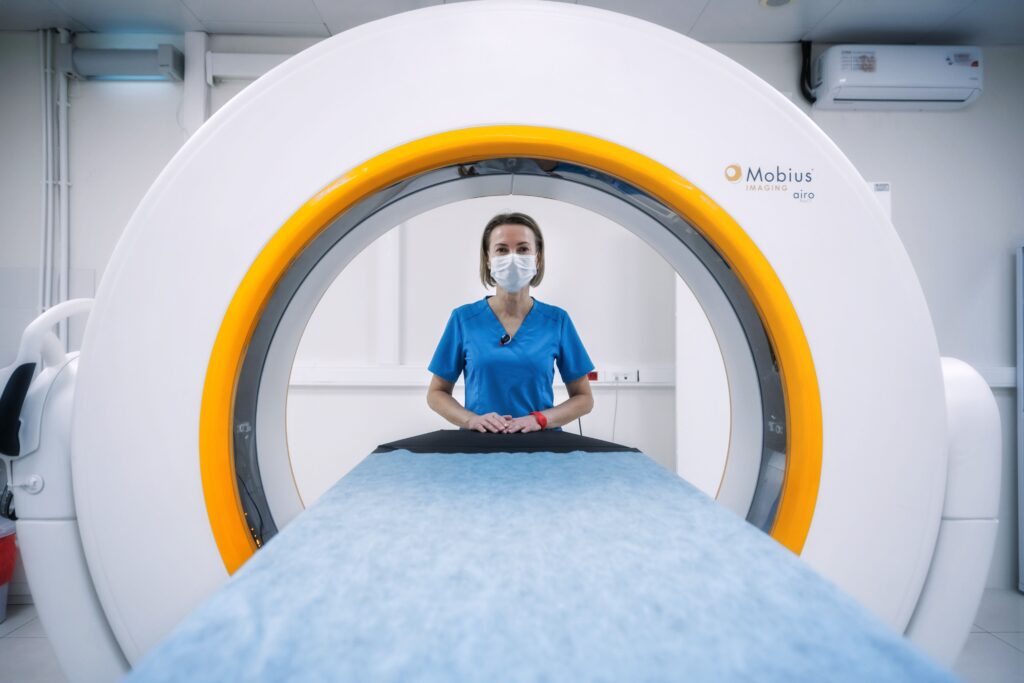
Worth understanding before the numbers, because the job explains the pay. Radiation therapists operate linear accelerators to deliver targeted radiation doses to cancer patients, following a treatment plan devised by a radiation oncologist and a medical physicist. The work involves positioning patients with millimetre precision, verifying the plan against imaging, monitoring the patient throughout, and documenting every session.
Most patients come in daily for weeks at a time, so therapists build genuine relationships with people going through the hardest period of their lives. It’s clinical work with a heavy human component — and that combination of technical precision and emotional weight is exactly why the role is compensated the way it is.
Why radiation therapists are paid so well
Three things explain the high figure. First, the work is high-stakes: therapists deliver precise doses of radiation to cancer patients, where errors are not an option. Second, the credential is specialised — an ARRT-certified associate or bachelor’s degree that relatively few people complete. Third, supply is tight: the BLS projects only 2% employment growth, but with so few new entrants, qualified therapists remain in demand and command strong, stable wages. It’s a classic case of a small, specialised field paying a premium.
Pay by state: where radiation therapists earn the most
Location creates a swing of more than $90,000 between the top and bottom states. California leads by a wide margin at a median of $166,450, followed by Oregon, New York and New Jersey, all near $130,000, while West Virginia sits lowest at $71,590. Large Southern states fall in between: Texas ($105,770), Louisiana ($94,710) and Georgia ($94,460).
| State | Median annual salary | Median hourly wage | Average annual salary |
|---|---|---|---|
| California | $166,450 | $80.02 | $161,890 |
| Oregon | $131,600 | $63.27 | $132,500 |
| New York | $129,620 | $62.32 | $129,690 |
| New Jersey | $129,460 | $62.24 | $137,970 |
| Washington | $125,880 | $60.52 | $148,520 |
| Hawaii | $125,520 | $60.35 | $122,670 |
| Illinois | $124,600 | $59.91 | $114,470 |
| Connecticut | $116,170 | $55.85 | $116,830 |
| Kansas | $108,830 | $52.32 | $112,750 |
| Arizona | $108,760 | $52.29 | $111,000 |
| Colorado | $108,020 | $51.93 | $110,640 |
| Utah | $107,660 | $51.76 | $115,170 |
| Maryland | $107,120 | $51.50 | $107,270 |
| Massachusetts | $106,300 | $51.10 | $112,170 |
| New Hampshire | $106,270 | $51.09 | $102,230 |
| Texas | $105,770 | $50.85 | $129,700 |
| Montana | $105,400 | $50.67 | $109,190 |
| Virginia | $103,310 | $49.67 | $109,790 |
| Maine | $101,980 | $49.03 | $111,460 |
| Vermont | $101,060 | $48.59 | $106,510 |
| Florida | $100,920 | $48.52 | $100,480 |
| South Carolina | $100,790 | $48.46 | $100,690 |
| Pennsylvania | $100,540 | $48.34 | $101,110 |
| District of Columbia | $100,250 | $48.20 | $112,400 |
| New Mexico | $100,010 | $48.08 | $99,010 |
| Missouri | $99,890 | $48.03 | $99,520 |
| Idaho | $99,660 | $47.92 | $100,170 |
| North Carolina | $99,250 | $47.72 | $99,680 |
| Nebraska | $98,670 | $47.44 | $114,800 |
| Ohio | $98,650 | $47.43 | $102,160 |
| Oklahoma | $98,390 | $47.30 | $96,510 |
| Minnesota | $98,000 | $47.11 | $97,140 |
| Kentucky | $97,760 | $47.00 | $105,000 |
| South Dakota | $97,470 | $46.86 | $106,820 |
| Indiana | $96,690 | $46.49 | $95,500 |
| Michigan | $95,890 | $46.10 | $95,400 |
| Louisiana | $94,710 | $45.54 | $95,730 |
| Georgia | $94,460 | $45.41 | $99,010 |
| Wisconsin | $93,600 | $45.00 | $95,270 |
| Nevada | $92,990 | $44.71 | $107,250 |
| Mississippi | $88,100 | $42.36 | $87,940 |
| Alabama | $87,330 | $41.99 | $85,760 |
| Tennessee | $83,520 | $40.15 | $88,630 |
| Iowa | $81,610 | $39.24 | $86,080 |
| Arkansas | $78,950 | $37.96 | $90,030 |
| West Virginia | $71,590 | $34.42 | $78,310 |
All state figures are official BLS estimates for May 2025. A few states are not listed because the BLS does not publish a reliable figure for them.
Where radiation therapists work
Setting shapes both pay and pace. Hospitals employ the largest share and typically offer the strongest benefits, pension contributions and the widest case mix, including inpatient and complex cases. Outpatient cancer centres and physicians’ offices often pay competitively with more predictable Monday-to-Friday hours, since radiation treatment is scheduled rather than emergency work — one of the few clinical roles with almost no overnight call.
Large academic medical centres pay well and offer access to advanced techniques like proton therapy and stereotactic radiosurgery, which build the specialised experience that lifts long-term earnings. Rural and smaller facilities sometimes pay premiums simply to attract qualified therapists to areas with a limited candidate pool.
How to earn at the top of the range
Reaching that $156,710 top decile usually comes down to four moves:
- Advanced modality experience — proton therapy, stereotactic radiosurgery (SRS) and brachytherapy carry premiums, because few therapists are trained on them.
- Dosimetry — moving into medical dosimetry, planning the treatments rather than delivering them, is the clearest step up in both pay and responsibility.
- Lead or chief therapist roles — supervising a department, managing scheduling and training junior staff.
- Relocation — a state gap of more than $90,000.
How radiation therapy compares to other healthcare careers
At a median of $105,310, a radiation therapist out-earns almost every other two-year healthcare role — more than an MRI technologist, a radiologic technologist, a respiratory therapist or a dental hygienist ($98,100). The roles that clearly beat it, nurse practitioners ($132,300), physician assistants ($135,880) and nurse anesthetists ($236,590), all require a master’s degree or doctorate first. For the full picture, see our ranking of the highest paying healthcare jobs in the USA.
The honest trade-offs
Two things deserve saying plainly. The job growth is slow at 2%, which means openings can be competitive, and in some regions you may need to be geographically flexible to land your first role — the flip side of a small, well-paid field.
And the work carries real emotional weight. You treat cancer patients daily, often for weeks at a time, and not every outcome is good. Most therapists describe the relationships they build as the best part of the job, but it isn’t a role you can do at arm’s length. Anyone considering the path should weigh that as seriously as the salary.
Frequently asked questions
How long does it take to become a radiation therapist?
Most radiation therapists qualify through a two-year associate degree in radiation therapy, then earn ARRT certification. A bachelor’s degree is also common and can open the door to dosimetry and supervisory roles that pay even more.
Is radiation therapy a good career in 2026?
Financially, yes — a median above $100,000 from a two-year degree, with even entry-level pay near $80,000 and strong job stability. The trade-offs are slow job growth (so openings can be competitive) and the emotional weight of working daily with cancer patients.
What’s the difference between a radiation therapist and a radiologic technologist?
A radiologic technologist takes diagnostic images like X-rays, with a median near $80,110. A radiation therapist treats cancer by delivering targeted radiation, and earns considerably more — a median of $105,310, reflecting the higher stakes and specialisation.
Do radiation therapists work nights and weekends?
Rarely. Radiation treatment is scheduled rather than emergency care, so most therapists work regular weekday hours — one of the few clinical roles with predictable scheduling.
Those figures are gross, and the best-paying states for this job are mostly high-tax ones: California, Oregon, New York and New Jersey top the table, and all four levy significant state income tax. Washington, fifth at $125,880, charges none at all. Check what a specific offer is worth after tax with our US take-home pay calculator.
To see how $105,310 compares with every job in the country, read our guide to the average salary in the USA. The BLS covers education, certification and the job outlook in its Occupational Outlook Handbook entry for radiation therapists.