
Australian plumbers take home about 32% more after tax, but they work longer weeks and need a licence the UK never asked them for.
The plumber salary UK vs Australia gap is real, but smaller than for some other trades. The median full-time plumber in Australia earns A$103,480 a year (Australian Bureau of Statistics, May 2025), about £54,463 at A$1.90 to the pound. In the UK, the median full-time plumber earns £39,179 (Office for National Statistics, April 2026). That is a gross gap of about 39%, and after tax it is still around 32%. A fair comparison also has to count the longer Australian working week, the cost of living, the 12% superannuation employers pay on top, and one thing that surprises many UK plumbers: in Australia, plumbing itself is a licensed trade. This guide works through each one with official figures.
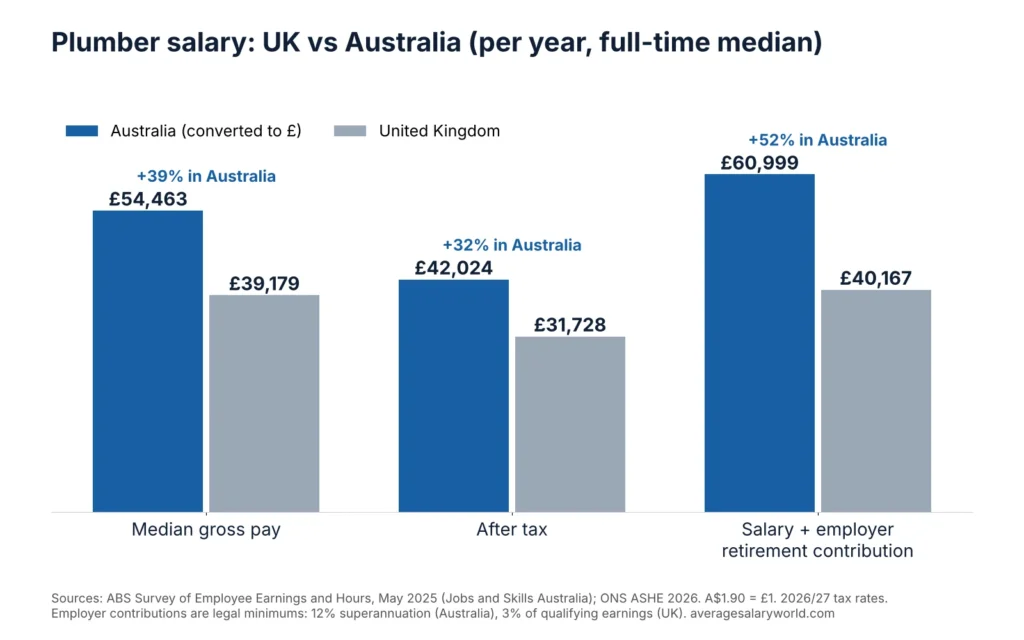
Plumber salary UK vs Australia: the official numbers
Both figures are medians for full-time employees, from each country’s national statistics office, so the comparison counts the same kind of worker on each side. Neither includes self-employed plumbers, who are a large part of the trade in both countries. Take-home pay uses 2026/27 tax rates in both countries.
| Measure (full-time plumbers) | Australia | Australia in £ | UK |
|---|---|---|---|
| Median gross pay a year | A$103,480 | £54,463 | £39,179 |
| After income tax and Medicare / National Insurance | A$79,846 | £42,024 | £31,728 |
| Take-home a month | A$6,654 | £3,502 | £2,644 |
| Median pay per hour | A$47 | £24.74 | £19.00 |
| Typical hours a week | 44 (average) | — | 40 (paid) |
| Employer retirement contribution (minimum) | A$12,418 (12% super) | £6,536 | £988 (3% pension) |
| Salary plus employer contribution | A$115,898 | £60,999 | £40,167 |
Sources: Australian Bureau of Statistics, Survey of Employee Earnings and Hours, May 2025, published by Jobs and Skills Australia (plumbers, A$1,990 a week × 52); ONS Annual Survey of Hours and Earnings 2026 (provisional), full-time plumbers and heating and ventilating installers and repairers (SOC 5315). Converted at A$1.90 = £1 (ECB reference rate). Australian take-home after income tax and the 2% Medicare levy; UK take-home after income tax and National Insurance, England, Wales and Northern Ireland rates. Retirement contributions are legal minimums: 12% superannuation in Australia, 3% of qualifying earnings in the UK.
On these figures, a median Australian plumber keeps about £3,502 a month after tax, against £2,644 in the UK: roughly £860 a month more. Tax does not explain the gap. On their median salaries, Australians pay about 23% of gross in income tax and Medicare, and UK plumbers about 19% in income tax and National Insurance. The difference is the pay itself.
Part of the gap is longer weeks
Full-time plumbers in Australia work an average of 44 hours a week, according to Jobs and Skills Australia, against a median of 40 paid hours for UK plumbers. So some of the annual difference is simply more time on the tools. It does not disappear by the hour, though. The median Australian plumber earns A$47 an hour, about £24.74, against £19.00 in the UK: roughly 30% more for each hour worked. Longer weeks explain a small part of the annual gap, and higher rates explain most of it.
The hidden 12%: superannuation
Australian salaries are quoted before superannuation, the compulsory retirement saving employers pay on top. Since July 2025 the minimum is 12% of ordinary earnings, worth about A$12,418 a year on the median plumber’s salary. In the UK, the legal minimum employer pension contribution is 3% of qualifying earnings, about £988 on the median. Add each country’s minimum employer contribution to the salary and the median Australian package is worth about £60,999 against £40,167 in the UK: a gap of around 52% before tax. Most comparisons of the two countries leave this out entirely.
Does the cost of living cancel it out?
Partly, not entirely. Australia is more expensive than the exchange rate suggests: using the OECD’s purchasing-power figures, prices there work out about 8% higher relative to the UK than the market rate implies. Adjusting for that trims the after-tax advantage for plumbers from about 32% to about 23%. Housing is the big variable. Rents in Sydney and Melbourne can absorb a large share of the difference, while Perth, Brisbane and regional cities change the sums again. If you are weighing a move, the city matters as much as the country.
To test your own figures, enter your UK salary in the calculator below, with “Plumber” already selected. It places you at the same point on the Australian pay scale and compares take-home pay in both countries.
UK vs Australia Pay Calculator
Pick your job and enter your UK salary to see what the same role pays in Australia, before and after tax, on official earnings data.
| UK | Australia |
|---|
How it works: we place you at the same point relative to typical pay for your job. If you earn 10% above the UK median for your occupation, we compare you with someone earning 10% above the Australian median. Medians are for full-time employees: Australia from the ABS Survey of Employee Earnings and Hours (May 2025), the UK from the ONS Annual Survey of Hours and Earnings (April 2026, provisional). Tax uses 2026–27 rules for a single employee with no other income (UK figures for England, Wales and Northern Ireland). Australian pay is converted at A$1.90 to £1 (ECB, 5 October 2026). Superannuation is paid by the employer on top of salary. Not included: student loans, pension contributions, the Medicare Levy Surcharge, state or regional pay differences and visa costs.
Getting licensed in Australia: the step most guides skip
This is the biggest practical difference between the two countries. In the UK there is no general licence for plumbing: the legal requirement is Gas Safe registration for gas work, and most plumbers qualify through an NVQ or an apprenticeship. In Australia, every state and territory licenses or registers plumbers, and working without the right licence is an offence. A qualified UK plumber starts with Trades Recognition Australia (TRA):
- Offshore skills assessment. Plumbers are assessed through TRA’s Offshore Skills Assessment Program (OSAP), carried out by TRA-approved training organisations, some of which assess applicants in the United Kingdom. The stages are documentary evidence of your qualifications and experience, a technical interview and a practical assessment.
- Offshore Technical Skills Record (OTSR). A successful result gives you an OTSR. With it you can apply to a state or territory regulator for a provisional licence or registration. In Victoria, Queensland, Western Australia and Tasmania it lasts 12 months.
- Supervised work and gap training. On a provisional licence you work under supervision while you complete “Australian context” gap training. In several states you need the Australian Certificate III in Plumbing before a full licence is issued. Much of the training covers the Australian plumbing and drainage standards (AS/NZS 3500), which differ from UK practice.
Budget for it. TRA’s published OSAP fees are A$1,280 for the documentary evidence stage, A$2,000 for the technical interview and A$2,200 for the practical assessment, so up to A$5,480 if you need all three, before visa costs, flights and a period on supervised pay. Gap training is charged separately and varies by state. Fees change, so check the current figures with TRA before you apply.
Gas is a separate question. Gas Safe registration is not recognised in Australia, and gasfitting is licensed as its own class of work by each state. If gas is a large part of your UK income, ask the regulator in the state you are moving to what you will be allowed to do on a provisional licence.
Visa routes for UK plumbers
Plumber (General) is on Australia’s Core Skills Occupation List, which means an approved employer can sponsor you on the Skills in Demand visa. It is also eligible for the points-tested skilled visas that do not need an employer (subclasses 189, 190 and 491), which require a skills assessment from TRA, an English test and an expression of interest. Occupation lists are reviewed regularly, so confirm the current position with the Department of Home Affairs before planning a move. For many UK plumbers, a sponsored job offer is the most practical route, because the employer can also provide the supervised work a provisional licence requires.
Where the money is in each country
The Australian median hides a wide range, and it has a firm floor: from 1 July 2026 the national minimum wage is A$26.44 an hour, and award minimum rates, including those covering plumbing, rose 4.75% the same day. Because the ABS figures date from May 2025, those rises mean the Australian median above, if anything, understates current pay.
In the UK, the middle half of full-time employed plumbers earn between £32,721 and £47,096, and the lowest-paid tenth earn under £26,510. The ceiling is reached mainly through gas and heating work and through self-employment, which the official figures do not capture. Our plumber salary UK guide covers pay by region and the self-employed side in detail, and the gas engineer salary UK guide covers the gas route.
Should a UK plumber move to Australia?
On the numbers, the case is good: higher pay before and after tax, higher pay per hour, and a much larger employer retirement contribution. But the gap is narrower than for electricians moving from the UK to Australia, and the costs are real. You need a skills assessment, a period on a provisional licence (12 months in most states), gap training and the upfront expense of the visa and the move, and many Australian plumbers work longer weeks than you may be used to. For an employed plumber early in their career, with no property tying them to the UK, the financial case is clear. For someone self-employed with an established customer base and Gas Safe work in the UK, the comparison is much closer than the headline medians suggest, and the time spent rebuilding a licence and a client base in Australia has to be counted against it.
Planning the move to Australia?
Ready to make the move? Compare free, no-obligation quotes from up to 5 verified international moving companies. After you submit your request, they’ll contact you with their offers. (Partner service: we may earn a commission.)
Frequently asked questions
Do plumbers earn more in Australia or the UK?
In Australia. The median full-time plumber there earns A$103,480 a year (ABS, May 2025), about £54,463 at A$1.90 to the pound, against £39,179 in the UK (ONS, April 2026). After tax the gap is about 32%: roughly £3,502 a month in Australia against £2,644 in the UK.
Can a UK plumber work in Australia?
Yes, but not straight away as a fully licensed plumber. UK plumbers are assessed through Trades Recognition Australia’s Offshore Skills Assessment Program. A successful result gives an Offshore Technical Skills Record, which lets you apply for a provisional licence or registration in an Australian state or territory and work under supervision while you complete gap training for a full licence.
Is plumber on Australia’s skills shortage list?
Plumber (General) is on the Core Skills Occupation List used for the employer-sponsored Skills in Demand visa, and it is also eligible for points-tested skilled visas. Lists change, so check the current position with the Department of Home Affairs before applying.
How much does a plumber earn per hour in Australia?
The median full-time plumber in Australia earns A$47 an hour (ABS, May 2025, published by Jobs and Skills Australia), about £24.74. The UK median for full-time plumbers is £19.00 an hour (ONS, April 2026), so Australian plumbers earn roughly 30% more per hour.
Compare more jobs in our UK vs Australia salary comparison, which sets 24 occupations side by side, see the average salary in Australia, or look at the same trade in the US in our plumber salary USA guide. Official sources: Jobs and Skills Australia (ABS earnings data), the ONS Annual Survey of Hours and Earnings 2026, Trades Recognition Australia and the Department of Home Affairs.